

In flexographic printing, consistency and control are everything.
Every production run depends on hundreds of variables working together, but few components have as much influence over print quality as the anilox roll. Often described as the “heart of the printing process”, the anilox is responsible for delivering a precise and controlled amount of ink to the printing plate. When it performs correctly, printers achieve predictable colour, repeatable results and efficient production.
When it does not, the consequences are immediate and costly.
Colour variation, longer make-ready times, increased waste and unnecessary press adjustments can all be symptoms of an anilox that is no longer performing as it should.
For many years, anilox maintenance was largely reactive. A roll was cleaned when print quality began to decline, or investigated when operators noticed inconsistency on press. However, as customer expectations continue to increase and production costs rise, the industry is moving towards a more proactive approach.
The question is no longer simply:
“Is the anilox clean?”
The question is:
“Is the anilox performing at its optimum level?”
This change in mindset is driving a new approach to roll management, where advanced ultrasonic cleaning and accurate inspection work together to provide printers with greater control, better data and improved confidence in their production process.
A clean anilox is not necessarily a performing anilox
One of the biggest challenges in anilox maintenance is that appearance can be misleading.
An anilox roll may look perfectly clean under normal lighting yet still contain microscopic levels of contamination trapped deep within the engraved cells. Ink, coatings, adhesives and other residues can gradually reduce the available cell volume, affecting the amount of ink transferred during printing.
The result is often a slow decline in performance rather than an obvious failure.
Operators may compensate by adjusting ink pigmentation, changing press settings or accepting longer make-ready times, without realising the true cause lies with the anilox itself.
This is why inspection has become such an important part of modern anilox management.
Adrian Buratta, Sales & Marketing Director at Troika Systems, explains:
“Cleaning an anilox roll is only half the process. The real question is whether the cleaning has actually restored the roll to its optimum condition.“
Inspection provides the evidence needed to answer that question. By measuring cell volume, depth, geometry and surface condition, printers can understand what is happening beneath the surface and determine whether a roll has genuinely recovered performance or whether further action is required.

Cleaning restores performance, but measurement confirms it
The relationship between cleaning and inspection is fundamental.
A roll cannot be accurately assessed if contamination is still affecting the engraved cells. Without proper cleaning to 100% full available volume, measurement data may not reflect the true condition of the anilox, making it difficult to distinguish between temporary contamination and permanent wear.
This distinction is critical.
A blocked cell and a worn cell may both result in reduced volume, but they require completely different solutions. One requires effective cleaning; the other may indicate that the roll needs repair or replacement.
This is where advanced ultrasonic cleaning plays such an important role.
Modern anilox rolls are precision-engineered components, with increasingly high screen counts and extremely fine cell structures. These rolls require a cleaning method that removes contamination effectively while protecting the integrity of the engraving.
Alphasonics UCS explains:
“Advanced ultrasonics is the optimum methodology for anilox cleaning. When undertaken regularly, the technology is quick, safe and effective, with minimal waste. However, not all ultrasonic cleaning systems are specifically designed for this high-end application, so choosing the correct technology and supplier is essential.“
Unlike aggressive cleaning approaches that rely on physical force, ultrasonic cleaning uses controlled sound energy to remove contamination evenly throughout the engraved surface.
The objective is not simply to make the roll look clean.
The objective is to restore the roll as close as possible to its available working condition.
Why inspection is becoming a critical part of preventative maintenance
As the printing industry becomes more data-driven, inspection is moving from being an occasional diagnostic tool to an essential part of preventative maintenance.
Historically, many maintenance decisions were based on experience and visual assessment. If a roll looked clean, it returned to production. If print quality dropped, investigation began.
Today, manufacturers are increasingly recognising that measurable data provides a much clearer picture.
Inspection technologies such as the Troika EVO™ allow printers to analyse the true condition of an anilox roll through detailed 3D measurement.
Rather than relying on assumptions, printers can monitor:
• Cell volume and capacity
• Cell depth and geometry
• Surface condition
• Wear patterns
• The effectiveness of cleaning processes
This information creates a performance history for each roll, allowing manufacturers to identify trends and make smarter decisions. Where that history is held in a global roll database such as the Troika Management System™, trends in volume and wear are visible per roll and across sites, so replacement and refurbishment decisions are made on evidence rather than assumption.
For example, comparing inspection data before and after ultrasonic cleaning can show whether reduced performance was caused by contamination or genuine wear. Over time, this information allows businesses to predict when maintenance will be required and avoid unexpected production problems.
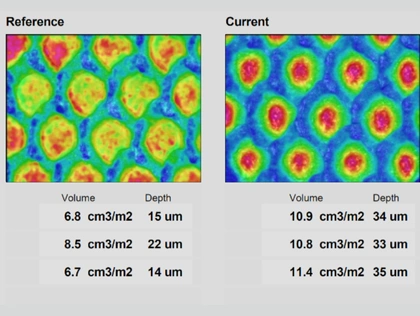
With modern instruments completing a full scan in seconds, routine before-and-after measurement becomes a practical part of everyday maintenance rather than an occasional exercise. Cleaning reports in the Troika software place the pre-clean and post-clean scans side by side, and because scan-to-scan repeatability is tightly controlled, operators can be confident that the difference they see reflects the roll, not the measurement.
Turning anilox maintenance into a measurable process
The biggest shift happening within the industry is the move away from treating anilox rolls as consumable items and towards managing them as valuable production assets.
A structured maintenance programme built around cleaning and inspection delivers benefits throughout the entire print operation.
When cell volume is maintained correctly, ink transfer becomes more stable, improving colour consistency and reducing variation between jobs.
With more predictable ink delivery, printers can reduce unnecessary adjustments and minimise ink consumption caused by compensating for poor roll performance.
Production teams also benefit from reduced downtime. Instead of spending valuable hours troubleshooting press issues, operators have accurate information about the condition of the anilox and can address problems much faster.
Perhaps most importantly, effective maintenance extends the working life of the roll. Many anilox rolls are replaced because they are assumed to be worn, when in reality they may simply be contaminated or incorrectly maintained.
Accurate measurement removes that uncertainty.
The future of anilox management is predictive
The future of anilox maintenance will be defined by prevention rather than reaction.
As inspection technology becomes faster, more accessible and increasingly integrated into production environments, more printers will adopt data-led maintenance strategies.
Rather than waiting for print quality problems to appear, manufacturers will use historical performance data to understand how rolls behave over time, when cleaning is required and when replacement is genuinely necessary.
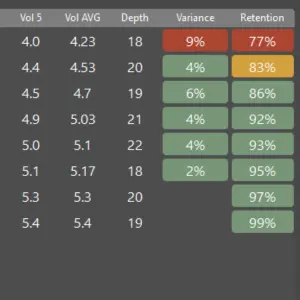
This approach brings greater control, reduced waste and improved profitability.
The printers that succeed in the future will be those that recognise the anilox roll for what it truly is: a precision asset that directly influences the success of the entire production process, as well as the direct effect poor maintenance and control has on profitability.
The message from both Troika and Alphasonics UCS is clear:
Clean thoroughly. Measure accurately. Maintain proactively.
Because advanced ultrasonic cleaning safely restores performance.
Inspection protects it.
And together, they provide the foundation for consistent, efficient and future-ready flexographic printing.
For more information about Alphasonics visit:
Alphasonics.co.uk